


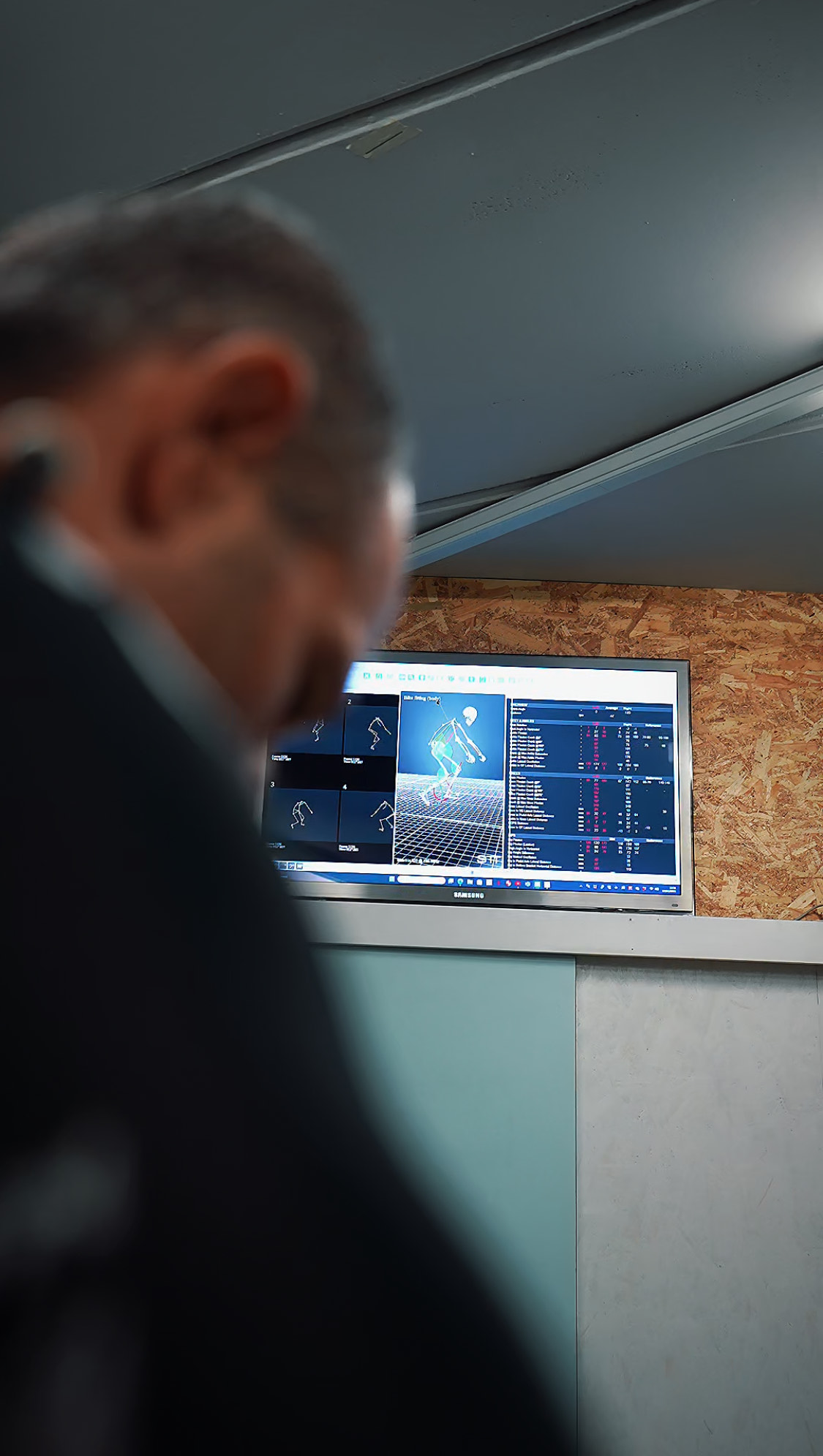
Luca Riceputi is a leading figure in the world of cycling and sports performance. With a solid background in Movement Science, Massotherapy, and Manual Therapy, as well as years of experience as a competitive cyclist, Riceputi combines science, technique, and passion to offer professional bike fitting, personalized training, and injury prevention services.
His holistic approach views the cyclist as a complete system, addressing physical, mental, and emotional aspects. Throughout his career, he has worked with elite cyclists, including Vittoria Bussi, the 2023 women’s world hour record holder. He has also developed training programs and analysis systems that apply scientific evidence and advanced technology like 3DMA.
This article explores his story, education, work philosophy, professional services, and real case studies that demonstrate how advanced bike fitting can transform pedaling performance and optimize athletic output.
Background and professional journey
From an early age, Luca Riceputi showed a natural interest in sports, influenced by his family. He practiced football, athletics, beach volleyball, swimming, skiing, and snowboarding, but it was mountain biking that ultimately captured his passion.
After high school, he spent several intense years working as a freestyle bartender and completing civil service. These experiences taught him discipline, commitment, and resilience. His enrollment at the University of Urbino to study Movement Science marked a turning point, merging his passion for sports with a rigorous academic foundation.
With the support of his colleague Mirco, he founded EssereBadSchool, a leading Bike Fit and training center in Cesena and Emilia Romagna, serving both road and MTB cyclists. Later, he co-founded Fisio & Essere, a physical medicine and rehabilitation center that integrates prevention, performance, and athlete wellness.
His approach combines technical training, physiotherapy, and biomechanical fitting, providing a comprehensive service that goes far beyond simple sports practice.
Academic and professional training
Luca Riceputi’s education combines academic study, technical certifications, and hands-on experience as an athlete. His main credentials include:
- Laurea Magistrale in Scienze Motorie: Master’s Degree in Movement Science.
- Diploma Triennale di Massofisioterapista e Massaggiatore Sportivo: Registered Massotherapist and Sports Masseur (Albo dei TSRM).
- Master in Manual Therapy and Osteopathic Techniques, IITM Bologna.
- Specialization in Osteopathic Spinal Manipulation, OMT Training (London).
- Sports Technician and Certified Bike Fitter (road and MTB).
- Advanced certifications: Magneticdays, IdMatch Bike Lab Selle Italia, and Born To Run.
- Co-founder and creator: EssereBadSchool and EssereBadSchoolSystem.
- Founder and partner: Sport Science Academy, Centro Essere, and Fisio & Essere.
His methodology integrates applied science, practical experience, and advanced technology, allowing him to deliver personalized training and professional bike fitting adapted to each athlete.
Technology and science at the service of professional cycling
Behind every biomechanical study lies a story and a professional who observes, analyzes, and transforms movement into actionable data. In this case, that professional is Luca Riceputi, founder of EssereBadSchool and co-founder of Fisio & Essere. Luca combines a solid academic background with deep athletic experience. His work is grounded in scientific evidence and precision tools such as STT Systems’ 3DMA, with which he has collaborated on numerous studies and real-world cases, like the one presented below.
One of the main goals during a bike fitting is to provide the cyclist with maximum comfort while ensuring that the position remains sustainable over time. Being comfortable on the first day is not enough; if the posture does not adapt to physical or technical changes or to different types of terrain, it will eventually lead to pain, injury, and loss of performance.
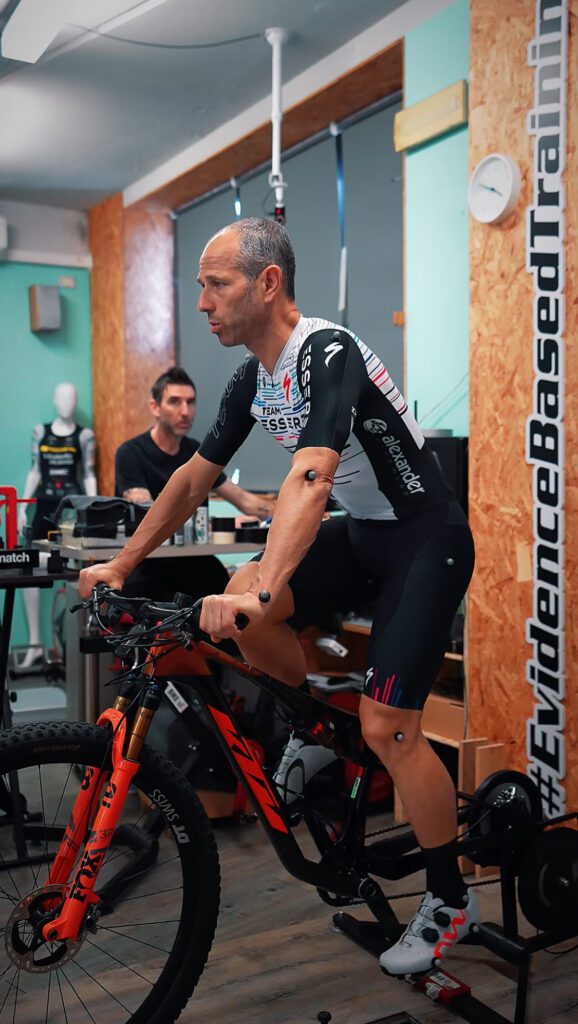
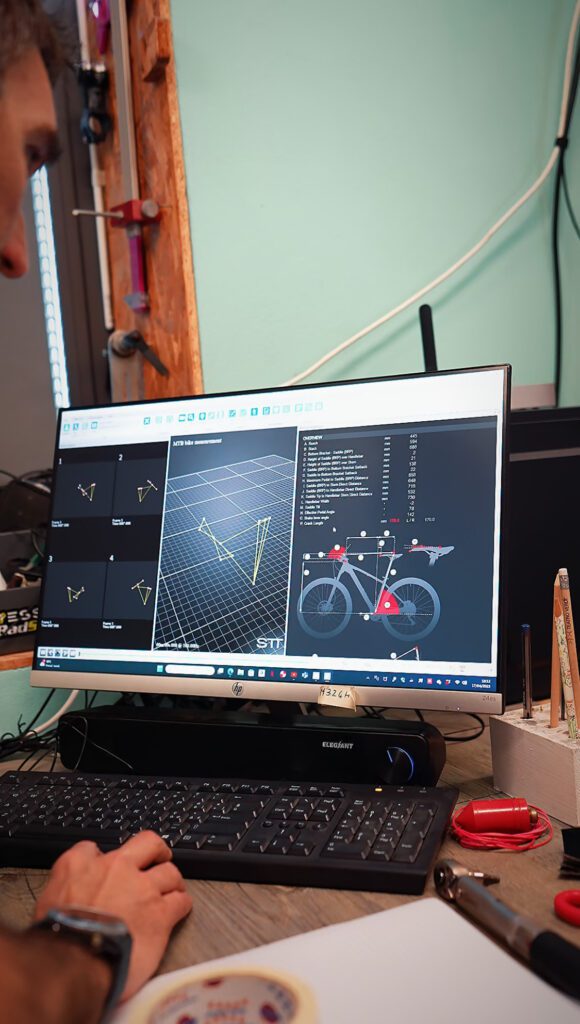
This is where biomechanical technology comes into play, specifically STT Systems’ 3DMA. It can perform a complete 3D analysis of the cyclist on the bike, calculate pedaling biomechanics, identify weight distribution along the bottom bracket axis, and visualize the center of gravity (COG), knee and ankle trajectories, pelvic rotations, and more, with a level of precision that few software solutions can match today.
A real case: lower back, knee, and wrist pain
We’re looking at an amateur MTB rider who has been cycling for only a few months and presents a fairly common but complex combination of symptoms:
- Lower back pain.
- Anterior pain in the right knee (especially on the outer side).
- Bilateral discomfort in both wrists.
During the assessment, he reported experiencing these pains since he began cycling, with increasing intensity over time. He rides three times a week for about three hours per session on technical routes with 1,500-2,000 meters of elevation gain. He participates in races but mainly aims to enjoy riding pain-free, especially during technical descents where frame handling is crucial.
Physical findings:
- Good pelvic anteversion/retroversion mobility
- Shortened posterior muscle chain
- Noticeable pelvic rotation
- Previous fractures: left clavicle and both radii
- Quadriceps rectus femoris contraction (possible overload)
- Rigid forearm musculature
First assessment phase: the importance of 3D
Thanks to STT Systems’ 3DMA, we were able to analyze the cyclist’s biomechanics in detail:
- Pedal stroke with rotation, bringing the right knee into adduction
- Compensatory rotation of shoulders and feet
- Saddle too high, preventing a smooth, circular pedal motion
This is where 3D analysis makes the difference. We didn’t just observe the issue; we understood how it affected the entire kinetic chain. The system also revealed a shifted center of gravity, which explained the discomfort and lack of stability on descents.
Adjustments performed
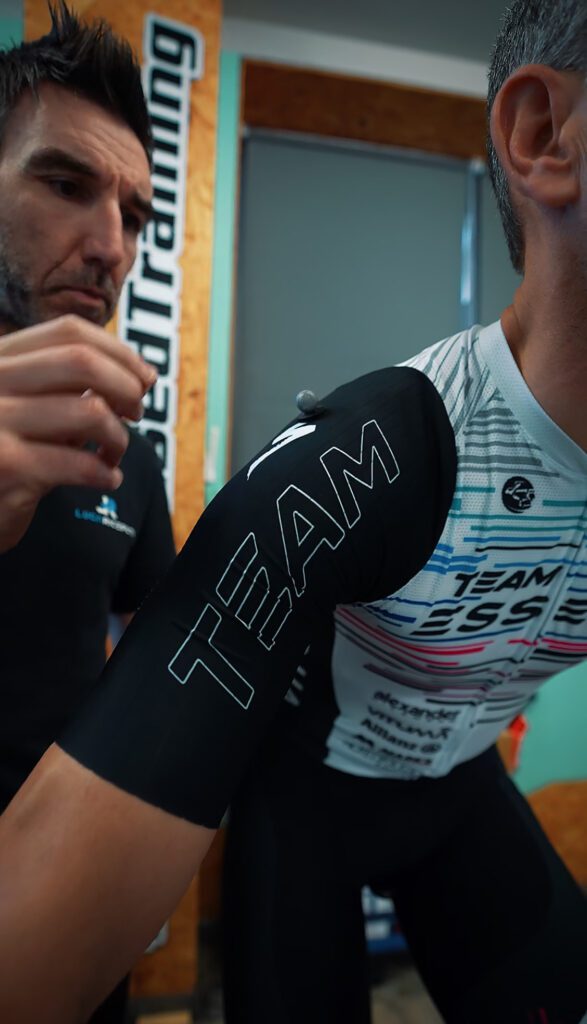
After reviewing the full history, rider demands, and technical evaluation, we began the fitting process:
- The saddle underwent several key changes: its height was reduced, it was shifted forward, and its inclination was adjusted from a positive to a slightly negative tilt. These modifications improved the interaction between the rider and the bike.
- As a result, the knee flexion angle decreased significantly, falling within the optimal range of 137°–147°. This reduced anterior knee stress and promoted pelvic anterior tilt, restoring the natural lumbar curve.
The handlebar and brake levers were also adjusted in their curve and position, which reduced wrist flexion angles and lowered accumulated stress on the forearm flexor and extensor muscles. This enhanced control and comfort while pedaling.
Results and feedback
Immediate feedback was positive, and the results were confirmed weeks later after multiple outdoor training sessions.
After the adjustments, the cyclist felt more balanced on the bike, regained stability during descents, and most importantly, experienced pain relief in all affected areas.
The center of gravity analysis confirmed better posture and alignment, directly translating to improved control and performance.
Immediate feedback was positive, and the results were confirmed weeks later after multiple outdoor training sessions.
This case perfectly illustrates how a data-driven, clinically informed approach using advanced technology like 3DMA of STT Systems can solve chronic issues for cyclists.
3D video analysis not only validates the changes made but also allows for interventions based on the reality of movement, not just on assumptions.
Because bike fitting doesn’t start with a tape measure; it begins with attentive listening and the integration of tools that respect the complexity of the human body in motion.
Would you like to see how STT Systems’ 3DMA works in real cases? Contact us and discover how 3D analysis technology can elevate your clinical practice.