


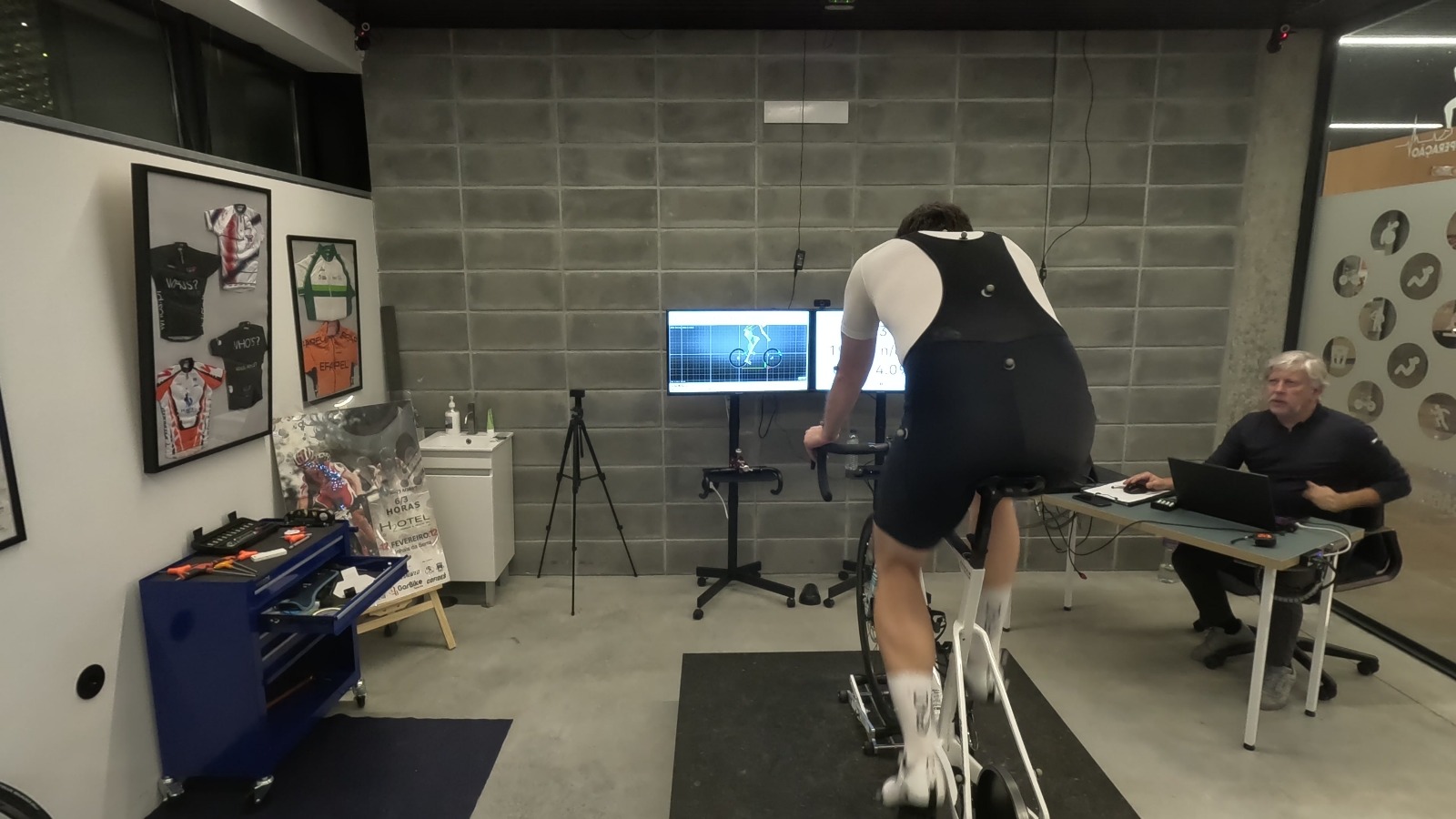
In the current world of professional bike fitting, where every millimeter matters and cyclist comfort becomes a decisive factor in performance, 3DMA technology has redefined precision standards. The work of Who’s Fit and its founder, Luís Martins, in Vila Nova de Famalicão, is a clear example of how applied biomechanics and 3D motion capture can completely transform the rider’s experience. The combination of over 25 years of experience and an advanced technological solution has allowed this studio to become a benchmark in Portugal.
Luís understood from the beginning that the ideal position on the bike does not appear in a measurement table. It is built from the real analysis of movement, the cyclist’s sports history, and their kinematic behavior under load. For this reason, he decided to integrate STT Systems’ 3DMA technology to offer a biomechanical adjustment service with precise, objective, and measurable data.
The Challenge of Modern Bike Fitting: Dynamic Precision
For years, bike fitting has been based on static approaches. Measuring saddle height with a tape, calculating angles with visual references, or adjusting the stem following general rules has been standard practice. However, a static analysis does not reflect what happens when the cyclist actually pedals. Pedaling is a dynamic phenomenon involving rotations, displacements, muscle compensations, and constant load variations.
Many cyclists consider discomfort such as lower back pain, neck tension, hand or foot numbness, knee overload, or pelvic instability to be normal. All these signs usually indicate problems in alignment and load distribution, associated with a poor fit or altered biomechanics.
The Vision of Luís Martins
For Luís, every cyclist has a unique physical structure, mobility level, way of generating power, and pedaling style. In his words, “every cyclist is a world.” No static formula can capture that real complexity. His mission was clear: to understand what happens during pedaling using real-time data and tools capable of revealing information the human eye cannot perceive.
He needed a solution that showed what happens during movement. The key was to move from assumptions to quantifiable and transparent biomechanical evidence. The tool that made this vision possible was 3DMA technology.
The Solution: Integration of 3DMA Technology at Who’s Fit
The STT Systems 3DMA system allowed Who’s Fit to capture cyclist movement in 3D with millimeter precision. Thanks to this technology, every phase of pedaling is analyzed objectively, from full knee extension to pelvic stability. The ability to measure these parameters in real-time marked a major change in Luís’s methodology.
What the 3DMA System Measures
The analysis performed by 3DMA records fundamental biomechanical parameters. Among them are knee extension and flexion in each cycle, hip flexion amplitude, pelvic rotations, trunk position, lower limb alignment, leg symmetry, and muscle compensations caused by restrictions or misalignments. Everything is represented graphically and quantifiably.
These data allow the identification of:
- Overloads in one of the legs
- Asymmetries generating efficiency loss
- Potentially injurious movements
- Joint restrictions
- Changes in technique when increasing power
- Loss of stability affecting performance
The true strength of the system is that every decision is supported by objective data, eliminating any type of intuitive interpretation or trial-and-error adjustment.
From Subjectivity to Objective Evidence
With 3DMA technology, Luís can show the cyclist on screen how a minimal modification in saddle height or setback alters the knee angle or reduces lumbar load. The process becomes an educational experience where the cyclist understands exactly why each adjustment is made. This builds trust, reduces doubts, and facilitates decision-making.
Combination of 3D Analysis and Saddle Pressure Study
The 3D analysis is complemented at Who’s Fit with a saddle pressure study. This tool allows measuring weight distribution, pelvic stability, and overpressure zones. The data helps validate if the cyclist is supported correctly and if there is any displacement that could affect pedaling.
This dual assessment provides a comprehensive view of the cyclist in motion. Correcting the position not only increases comfort but also usually translates into an increase in power and a reduction in the effort required to maintain an optimal cadence.
Results Obtained by Who’s Fit After Integrating 3DMA Technology
The results have been clearly visible to both the cyclist and the studio itself. The customer experience has improved, the workflow is more efficient, and the perceived value of the service has increased.
Cyclists Without Pain and With Higher Performance
Users of Who’s Fit highlight significant improvements after the biomechanical adjustment session. Many reduce or eliminate chronic discomfort, such as back pain, knee issues, or hand numbness. Others report greater stability in the saddle and a more fluid sensation during long rides.
Furthermore, the cyclist understands their body more clearly. They receive explanations based on data that help them understand how their mobility, technique, and position relate to their performance and comfort.
More Efficient and Cyclist-Centered Workflow
The 3DMA system generates detailed and visual reports in a matter of minutes. This allows Luís to dedicate more time to interacting with the person undergoing the study and less time to manual calculations or verifications. The session becomes a professional, clear experience oriented toward data-driven decision making.
The result is a smoother process and a perception of higher quality by the end user. The combination of technological precision and personalized attention has generated a very positive effect on Who’s Fit’s reputation, especially through word-of-mouth among cyclists.
An Investment with an Evident Return
Luís states clearly that the investment in 3DMA technology has been a strategic decision that has raised the service level, increased the studio’s credibility, and generated a direct impact on customer satisfaction. Precision and objectivity have allowed them to differentiate themselves in a competitive market, creating a solid positioning within professional bike fitting in Portugal.
Why 3DMA Technology Sets a Standard in Advanced Bike Fitting
In the field of sports performance and injury prevention, precision is a non-negotiable value. 3DMA technology has positioned itself as a key tool for bike fitting professionals, physiotherapists, podiatrists, and sports centers aimed at offering advanced evaluations.
Its main advantages include:
- Real-time 3D motion capture
- High precision in measurements
- Identification of asymmetries and compensations
- Automatic generation of clear reports
- Optimal integration into evaluation protocols
- Greater professionalization of the service
Dynamic analysis has become a differentiator for those seeking to offer a complete and high-impact experience for the cyclist.
Final Reflection on the Value of 3DMA Analysis
The Who’s Fit case demonstrates that the future of bike fitting lies in advanced biomechanics and tools capable of measuring movement precisely. The combination of Luís Martins’ experience, personalized treatment, and STT Systems’ 3DMA technology has transformed every session into a cyclist-centered experience. The position is no longer a guess, but a direct consequence of objective data and a deep understanding of pedaling kinematics.
At Who’s Fit, the cyclist occupies the center of the process, and the results speak for themselves. 3DMA technology has allowed the creation of a service model based on evidence, comfort, performance, and constant evolution.