



In the world of combat sports, every millisecond and every degree of movement counts. A well-executed punch can be the difference between victory and defeat. Recently, an in-depth study led by Dr. Soyib Tajibaev an authority on sports biomechanics from the Uzbek State University of Physical Education and Sport, and Phd Ismoilov Ganisher, Assistant Professor Khojiev Shokhrukh and Assistant Rajemetov Abror, delved into the mechanics of a fundamental movement: the forward-step punch. This analysis, utilizing cutting-edge motion capture technology reveals crucial insights into how to optimize power, balance, and control in this type of punch.

The challenge
The primary goal of this study was to break down the complex sequence of movements that make up a forward-step punch, identifying the key biomechanical adjustments that contribute to the punch’s effectiveness. Understanding in detail how the body adapts and aligns during this movement can provide valuable information for improving training techniques, preventing injuries, and maximizing athlete performance.
Applied biomechanical solution
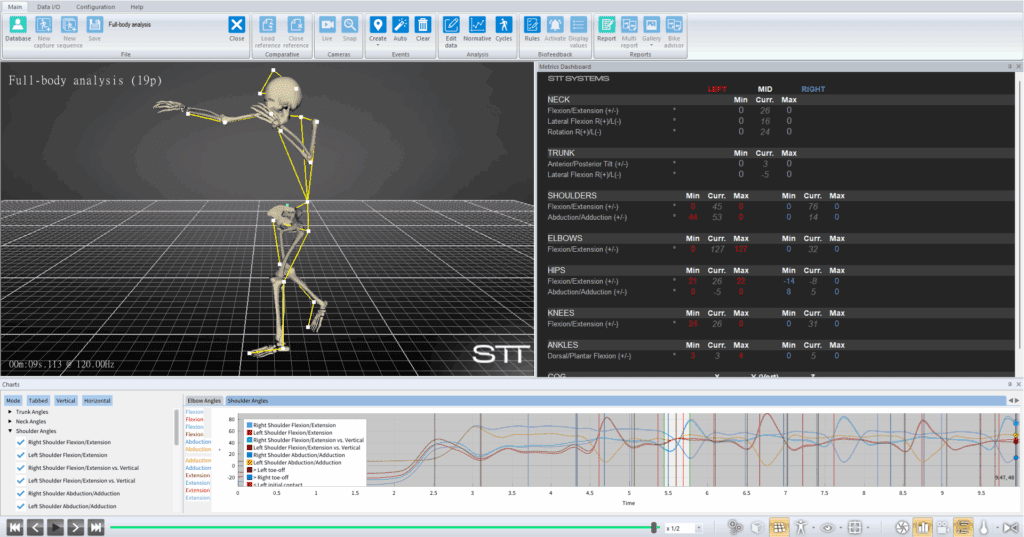
To meticulously analyze each phase of the movement, our optical 3D motion capture 3DMA was employed. The 3DMA optical system uses passive markers to track various body segments of the subject, and applies biomechanical calculations to obtain joint angles and the position of the center of gravity (COG) during the execution of the punch. The capture protocol allowed for detailed kinematic data from the initial position to the completion of the attack. Our system’s ability to capture complex movements in dynamic environments is key to understanding the true biomechanics of the sports gesture.
Although the provided text does not detail the integration with other technologies, in similar studies, synchronizing motion capture data with electromyography (EMG) to analyze muscle activation or high-speed video for complementary visual reference can further enrich the analysis.

Paper results: breaking down the punching biomechanics
The collected data revealed significant biomechanical adjustments in various parts of the body during the forward-step punch:
- Neck: A slight flexion (1°) and a notable left lateral tilt (34°) combined with substantial left rotation (72°) suggest an optimized visual focus and head alignment that supports trunk rotation.
- Trunk: An increase in forward flexion (9°) shifts the center of mass forward, crucial for momentum and stability. A slight right lateral flexion (1°) helps counterbalance the rotation.
- Shoulders: The left shoulder experiences extension (20°) and slight abduction (6°) to maintain balance. The right shoulder shows significant extension (52°) for reach and marked adduction (-76°) for direct, powerful contact.
- Elbows: The left elbow flexes slightly (11°) to maintain alignment, while the right elbow extends almost fully (-105°) to maximize force transfer.
- Hips: Greater flexion in the left hip (22°) and extension in the right hip (15°) propel the forward movement and weight transfer. Left hip adduction (21°) and slight right hip abduction (4°) align the lower body with the upper body’s rotation.
- Knees: Increased flexion in both knees (left 9°, right 13°) provides stability and helps absorb impact.
- Ankles: Subtle adjustments in left plantar flexion (-1°) and right dorsiflexion (11°) contribute to stability during weight shifting.
- Center of Gravity (COG): A decrease in COG height (21 units) indicates a lower, more stable posture upon punch completion, crucial for balance and control.
These results highlight the intricate coordination of the kinetic chain, where force is generated from the lower limbs, transferred through the trunk, and ultimately released in the punch with the upper limb. Dynamic stability and balance, facilitated by adjustments in lateral flexion and rotation, are essential for precision and power. Energy transfer efficiency through joint extensions minimizes force loss.
Want to optimize your athletes’ performance with advanced biomechanical analysis?
Withing STT Systems, the Motio division is leading the way in biomechanical analysis technology. Our solutions provide precise and insightful data to understand and enhance sports movement.
Would you like to achieve results like these in your gym, training center, or research laboratory?
Contact us today and discover how our technology can take motion analysis to the next level.